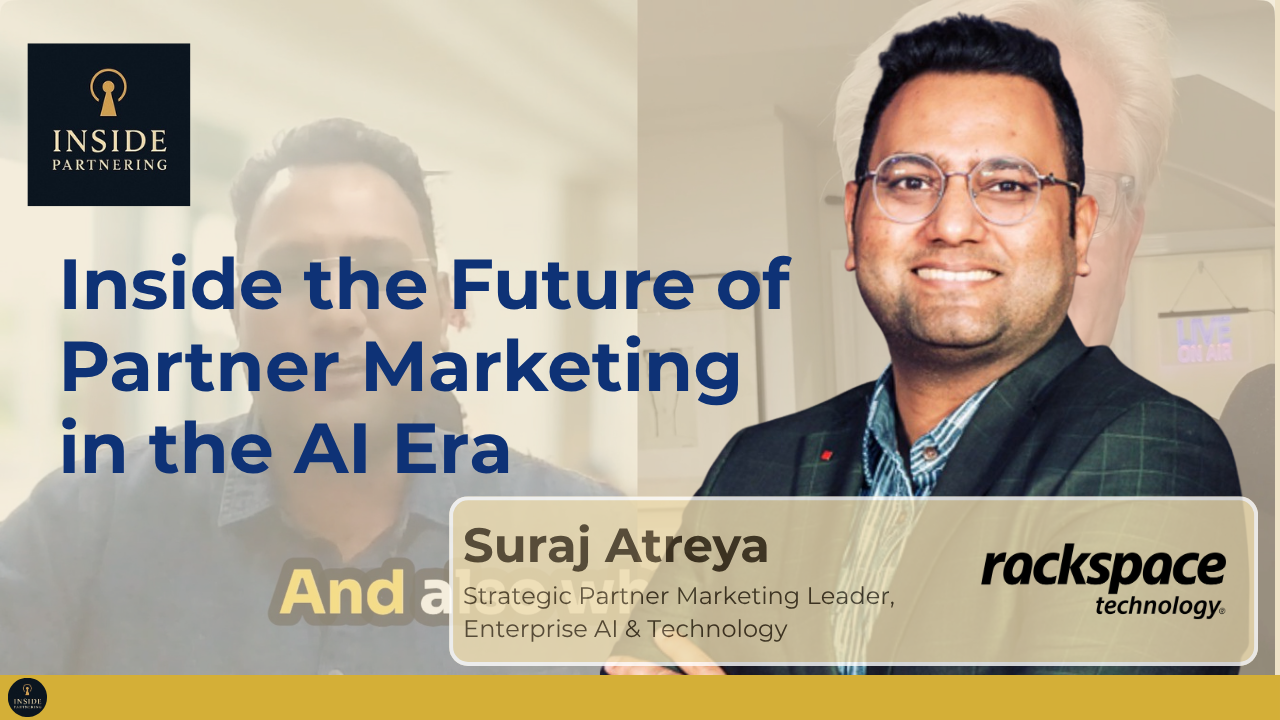
Episode Overview
The New Shape of Partner Marketing
Modern partner marketing is in the middle of a major shift. Buying patterns have changed, ecosystems have expanded, and AI has compressed what used to be six-month cycles into a matter of days.
In this conversation, Suraj Atreya of Rackspace Technology shares an inside view of how enterprise partner marketing is evolving, why alignment matters more than ever, and where the function is headed as organizations embrace the next wave of AI.
Why the Ecosystem Is Driving the New GTM Reality
Enterprises no longer buy monolithic stacks. They assemble solutions that span seven to ten technologies. That shift has completely reshaped the role of partner marketing.
In Suraj’s words:
“Today enterprises want to buy a mixed variety of solutions across the stack, and it is in that mix where partner marketing becomes a strong force to drive ecosystem led growth.”
This shift demands not just messaging alignment but also operational alignment among corporate marketing, product marketing, field marketing, and partner teams. As Suraj emphasizes, partner marketing now acts as connective tissue between corporate strategy, field execution, and the broader partner ecosystem.
Inside Partnering is a reader-supported publication. To receive new posts and support my work, consider becoming a free or paid subscriber.
AI Compression - From Six Months to Days
One of the most significant unlocks has come from AI’s ability to reduce the time and effort of creating partner ready content.
Suraj explains:
“Partner marketing was all about entering a big portal, downloading assets, and taking six months to customize. Today all that has come down to weeks and even days with AI.”
Vertical content, partner specific messaging, campaign-in-a-box assets, and persona-based storytelling can now be localized and deployed at a fraction of the time and cost.
But he also argues that the human layer remains critical. AI amplifies, but it does not replace, judgment, insight, and relationships.
“You as a human have very specific insights which AI can amplify, but not replace. It is human plus AI that scales partner marketing.”
Better Together Stories Need Field Buy-In
A good partner marketing program cannot stop at the marketing team. Suraj stresses that sellers - both your own and your partner’s - must fully believe in your better together narrative.
“The sellers and partner sellers need to buy into the better together story. It cannot be that marketing puts something on the website and the sales organization does not buy into it.”
This is where alignment becomes execution. Partner marketing must ensure that storytelling, enablement, and field motions reflect the same strategy, the same priorities, and the same value proposition.
ABM Evolving Into Account Based Ecosystems
Suraj also sees Account Based Marketing changing. Instead of focusing only on internal target accounts, ABM now incorporates partner signals, funding programs, incentives, and market intelligence from hyperscalers.
“ABM is now evolving to cover account based ecosystem. It is not just our target accounts, but also the synergies across partners and where they are focusing.”
This evolution creates highly focused motions tailored to specific accounts, regions, and use cases, all underpinned by shared data between partners.
The Power of Personalized, Human Social Selling
Something as simple as a LinkedIn post has become a powerful lever inside massive ecosystems. Suraj notes that partner sellers, architects, and marketers increasingly share stories not just from corporate handles but from their personal profiles.
This personal distribution drives trust.
“People buy from people they trust. A post from a person builds more trust than the corporate profile.”
That shift increases the reach and relevance of partner stories while improving brand perception inside partner organizations - an often overlooked priority.
Organizing for Ecosystem Success
Suraj believes the reporting structure (CMO, CRO, or Head of Partnerships) is less important than the scorecard and alignment. What matters is that all stakeholders agree on:
- shared outcomes
- shared metrics
- shared target accounts
- shared messaging
When partner marketing is evaluated on the same business outcomes as sales, alliances, and corporate marketing, the engine works.
Where Partner Marketing Goes Next
Suraj sees the next leap happening at the intersection of human leadership and agentic AI. Tools will accelerate content, planning, orchestration, and intelligence. But the biggest differentiator will be mindset.
In his view, leaders who thrive will be the ones who stay focused, execute clearly, and bring stakeholders together under one unified narrative.
Podcast
Guest
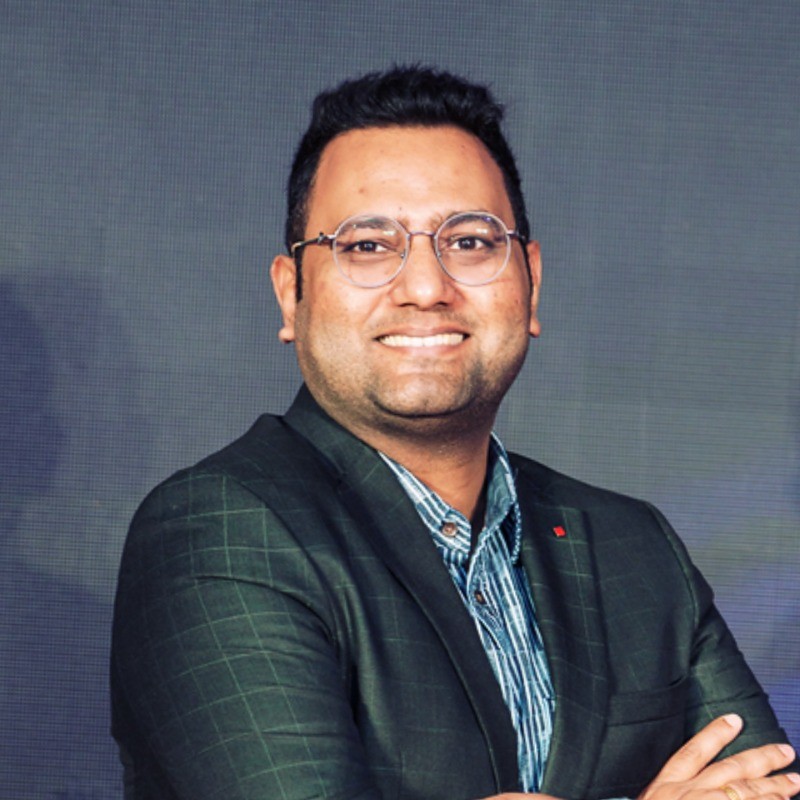
Suraj Atreya
I build global partner and ecosystem marketing engines that drive revenue growth for enterprise and AI-first technology companies. Over the past 15+ years, I have worked across the Americas, EMEA, and APAC helping organizations turn hyperscaler alliances and partner ecosystems into predictable pipeline and revenue. My work sits at the intersection of partner and ecosystem marketing, hyperscaler GTM, demand generation, and enterprise AI, with a consistent focus on measurable business outcomes.

Episode Transcript
Suraj Atreya
===
Suraj Atreya: [00:00:00] it is having the clarity around what is a better together story.
And then helping drive alignment not just from a marketing piece, but also from a field execution perspective. Because ultimately the sellers, the field sellers, as well as the partner sellers needs to buy into that better together story. It cannot be that marketing is just putting something on website and social media and the sales organization don't actually buy into it.
So I think that's the way I see this ecosystem play is bringing about clarity, bringing about alignment and bringing about getting people on board, right? And then having all of these teams work and grow in the same direction. And that's when I've seen marketing really move the needle from a revenue and partner perspective.
Chip Rodgers: Where is this all going? What do you see, what are best practices that you're seeing and what's the future of partner marketing?
Suraj Atreya: I think we are now at an inflection point where it's looking really interesting and the future is looking really exciting, right?
Chip Rodgers: Hey [00:01:00] everyone. Welcome back to another episode of Inside Partnering. I'm Chip Rodgers. And we're here on a Friday. For me it's Friday morning and Suraj your Friday evening. Actually, I think it's about nine o'clock. Your at night, your time. You're based in Bangalore and and end of the week for you.
Suraj Atreya: Yes, end of the week and looking forward to a good weekend. Love this opportunity to speak with you, chip. I've been following the Inside Partnering podcast from a long time. And it's an honor and privilege to be.
Chip Rodgers: That's fantastic. Thank you. Thank you as as a a listener. I appreciate it. I'm so excited to be joined by Suraj Atreya. Suraj is heads the partner marketing organization for covering EMEA for Rackspace. And just, love the work that you're doing.
You're also a a member of Partnership Leaders as well, and I think you've been putting together the Partnership Leaders group in in India and which is a growing, a growing movement as [00:02:00] well. Your background, four years now with with Rackspace and two years with
USEReady with two year for two years, and then prior to that with Moody's for eight years. You've had, quite a run. And I think also I noticed that your education background is from IIT Calcutta . I know the IIT schools in India are pretty tough to get into, so congratulations on that.
Suraj Atreya: Yeah, chip. It's actually the, IIM IIM is a management school. IIT is a technology school but yeah, both of them are equally tough.
Chip Rodgers: Yeah. Oh. Okay. IIM good to know. That's fantastic. Suraj, thank you for joining us today. Appreciate it.
Suraj Atreya: Thank you for having me here, chip looking forward to sharing my thoughts and perspectives.
Chip Rodgers: I think, why don't we start and just give us a sense of what your role is and what you and the team at Rackspace are up to these days in partner marketing.
Suraj Atreya: Great. So I'm primarily a marketing [00:03:00] professional and I've done marketing across the spectrum of B2B marketing started with content, digital brand solutions, product marketing, et cetera. And for the last five to seven years, I've focused extensively on partnerships and alliances marketing. So in my current remit at Rackspace I work with the cloud hyperscalers, the likes of AWS, Microsoft and Google in the Europe, middle East and Africa geography.
For Rackspace helping run co-marketing programs and marketing governance, ensuring that the dollars invested. Generate higher returns on investment and ultimately drives marketing success and partnership success and overall business growth in the region and for Rackspace globally. So that's a little bit about what I've been doing at Rackspace.
Like you said, prior to that, I started my career actually with Moody's Analytics and back in the days, been to New York City multiple times, working with global financial services financial products and AI and analytics and that [00:04:00] I've always had this fascination as a marketer to understand the enterprise AI and analytics landscape.
And it was in this adventure or this discovery that I happened to come across partnerships in my role at USEReady wherein USEReady is the. North American Tableau Partner of the year for multiple years running and also have strong partnerships with Snowflake and other data players.
So that's what really got interested for me as a marketer to explore enterprise AI and tech and understand how partnerships help to really drive this as a growth engine. And today I sit at the intersection of partnerships, marketing and revenue. And really helping various teams drive, go to market in an efficient and an integrated way with our partners.
Chip Rodgers: You're I your background is similar to mine. Mine is also, the sort of combination of a longtime marketer and and then when I joined WorksSpan. actually at SAP as well, I had quite a bit of [00:05:00] engagement with partners and building community and and things like that.
And then with WorkSpan, it's been all about partners. And so I, I have the same love that that I think you have of this combination of marketing and partners. So let's dive in.
Suraj Atreya: Absolutely. So Chip, when I looked into your profile, I, it was fascinating that you're also a Chief Marketing Officer and a Chief Partnerships Officer. A very rare combination today where the role of Chief Partner Officer is still rising. And we also happen to be partnership leader leaders members in the background.
Yes. Looking forward to diving deep.
Chip Rodgers: Yeah. Yeah. So why don't we start with with, let's just talk about the overall. Landscape. What's changing in partnerships and partner marketing, with AI so prominent and this sort of ecosystem led, go to market. What's, what are you seeing in your, from your perspective what's happening and what's new?
What's changing?
Suraj Atreya: So that's a [00:06:00] great question to set things off. Seeing this space of partner marketing has been growing rapidly and advancing. Drastically just in the last couple of years due to the advent of technology and ai. Just taking a step back from ai I think what is really fascinating is the way buying decisions are being made now, in enterprise technology.
So gone of the days where it is single organization offering all the solutions. So today enterprises want to buy a mixed variety of solutions right across this, the stack and typically the tech stack can have seven to 10 different solution players ISVs, et cetera, come and co-create that solution.
So it is in that mix, I think is where partner marketing is now, becoming a very strong force to drive this ecosystem led growth in, in the era of AI and partnerships. And what I've been seeing just in the. Couple of months is the advent of AI and the advent of personalized content [00:07:00] to do, to make partner relevant, partner marketing super relevant to field marketing and to run, join, go to market campaigns.
With specific partners because just as I started this role a couple of years back, partner marketing was all about getting into one big portal of a hyperscaler downloading their campaign content and assets, and then taking six months to customize those assets. Another three months to roll out.
And by the time the campaign assets may not really be useful, it may not be talking the language, but today all that has come down to a matter of weeks and matter of days with the advent of AI being able to.
Chip Rodgers: Yeah.
Suraj Atreya: Campaigns in a box and then go to market quickly with very strong personalized content content by vertical, content by partner, content by region which then really helps to drive field execution both from an event standpoint as in field events, digital events, and also from a content and thought leadership and helping build a brand holistically.
Customer and to the partner ecosystem. [00:08:00] So that's, it's been a really fascinating ride. And I think in the coming months it's going to be even more fascinating as we get more and more adoption and as when marketing marketers in general start adopting ai the opportunities are gonna be tremendous, but the human aspect is still extremely important.
What I keep telling my marketing peers is that you as a human. have very specific insights and skill sets, right? Which AI can help amplify, but not necessarily that AI is gonna replace. So I think it's that skill of human plus AI to really scale marketing campaigns with partners and with ecosystems is what makes this h so interesting.
Chip Rodgers: To what extent are one of the challenges with partnering and is getting the word out. It's. Kind of partner enablement, right? It's putting that better together story together and then getting that out to the partner. And there's so much new information hitting the field all the time [00:09:00] with just their own products.
But, to have them then pick up with, okay how does, how does Rackspace and AWS, what's the better together story there? For example how do you what's your role in that and how do you think about that? Challenge.
Suraj Atreya: I, the way I think about the revenue motion from a marketing perspective is really alignment of the different marketing teams. So as we all know, there is a corporate marketing team which owns the brand and the brand narrative, a product marketing team, which
Really does things like personas and customer pain points, et cetera.
And then partner marketing and field marketing. Which helps take those centralized messaging and add in a layer of regional nuances, add in a layer of partner complexity to drive campaigns in the region. And that is exactly what I'm seeing. It's today. It's not about is it's not about partner marketing versus brand marketing versus demand and marketing, but rather it's the.
All of these elements of marketing coming together as a whole [00:10:00] and working together with a shared scorecard, which talks about metrics which really matters for customers in terms of growth and install base growth in terms of new acquisition, new logos and marketing, total influence in pipeline, both from a partner perspective and even from a non-partner perspective.
And getting all these teams aligned and operating in a rhythm. Because I think that's when the magic really happens. And yeah, so I think today is the day of aligning all of these elements within B2B marketing to, to amplify the message and reach. Customers and partners in the right way at the right moment in time.
The other thing which, I've also seen, which is very interesting is today it is easy to do very specific focus. Partner plays and sales plays taking content and using that with a regional nuance and using that with a partner messaging
Chip Rodgers: Yeah.
Suraj Atreya: and but more than that, it is having the clarity around what is a better together story.
And then helping drive alignment [00:11:00] not just from a marketing piece, but also from a field execution perspective. Because ultimately the sellers, the field sellers, as well as the partner sellers needs to buy into that better together story. It cannot be that marketing is just putting something on website and social media and the sales organization don't actually buy into it.
So I think that's the way I see this ecosystem play is bringing about clarity, bringing about alignment and bringing about getting people on board, right? And then having all of these teams work and grow in the same direction. And that's when I've seen marketing really move the needle from a revenue and partner perspective.
Chip Rodgers: Yeah, it is a lot of a lot of alignment both with as you say, with, with sort of corporate marketing, product marketing within your own company, within the partners organization, and then field marketing and bringing that all together to get the word out.
Suraj Atreya: Absolutely. Yeah. It's clarity, integration and then getting all people to move in the same [00:12:00] direction.
Chip Rodgers: How do you, let's. You're talking a little bit about it but what would you say, what's your sort of definition of partner marketing? I think some, sometimes people hear partner marketing and they think, MDF, co-branding, those kinds of things. How would you define partner marketing within the modern enterprise business?
Suraj Atreya: A great question, Chip. In my opinion, modern partner marketing or partner marketing and enterprise AI and tech, it's not just about MDF and funding programs and, co-branded logos. Yes. All of that is there from a compliance and a process perspective. But if you look at it at a strategic level the way I see it as partner marketing today is a connective tissue between.
Corporate strategy field execution, and then ecosystem orchestration. What I mean by that is that at the corporate level there are certain directions that, for example, we need to be AI first or we need to be customer centric. And and then the field has [00:13:00] slightly different priorities in terms of.
Where the customers are in their enterprise journey, and that depends on, and that is different in different markets. And then there is the ecosystem partners for the likes of AWS, Microsoft, snowflake, et cetera who are really bringing those tech products. Which, and tech solutions which customers eventually use.
So I think that interplay is where partner marketing sits. The interplay between corporate strategy, field execution, and then that ecosystem orchestration getting all the stakeholders aligned and having clarity in the messaging. To then activate on campaigns, activate on both to customer and to partner programs, and then look at ROI from a very holistic lens.
So back in the days, when I started with marketing marketers were obsessed about, a number of leads, a number of clicks and number of MQLs and know click through rate and that kind of data. What I've noticed is, especially in 2025 marketing ROI is a lot more focused around [00:14:00] who are the exact set of target accounts? Are we reaching the right target accounts? the right messaging resonating with the right target accounts? And are we creating inroads from a new logo acquisition perspective and also for existing customers? What does upsell and cross sell play with partners and what does that motion look like?
And then I believe marketing leadership has a role to play in all of these elements and that's the beauty. B2B marketing today in enterprise tech, it's a lot more nuanced, but I think it's a lot more impactful because with ecosystem comes complexity, but there is also an opportunity to create impact at scale.
And I think that's what B2B marketing has in this moment in time onwards, creating impact in scale as against being perhaps like a back office function, as was the case, in the early days of marketing.
Chip Rodgers: To what extent do you, as you're talking, I'm just thinking, to what extent are you do, 'cause you talk about, target accounts and target target personas, sort of your ICP. [00:15:00] In enterprise buying , there's a whole. Buying committee. And so over the last five, 10 years, there's been this sort of move to account based marketing.
H how does that sort of overlay or, fit into the partner marketing scenario?
Suraj Atreya: So I think account based marketing is absolutely relevant in today's age. I recently published a thought piece saying that ABM is now evolving to cover account based ecosystem. And what I mean by that is the principles of a ABM are still relevant today. But it's not just focusing on this set of target accounts, which my field sales team wants to look at.
It's also looking at what are the synergies between what my Alliance partners are where are the accounts, where there are, for example, pre-funding committees where there are incentive programs. For example, in the case of AWS, there is a MAP program, right? Which AWS will fund for select.
Accounts and customers. So it's taking that intelligence and then gathering all [00:16:00] of this layer of ecosystem intelligence to then make a very calculated play. That here is what I'm going to do from an account based motion, but this is an account based motion for the ecosystem. And then we run the different phase, be it in-person events, thought leadership webinars, and, sales enablement to help drive these conversations and bring velocity to these deals..
Chip Rodgers: I love that. I think that's and then you have to align with the partner as well, and make sure that you're when, if you're doing, if you're running events, you're bringing in, maybe not just a direct buyer, but also you may have some. Some content or specific programs for, the CFO organization or for the security organization and those kinds of things.
So you're casting a wider net within the organization.
Suraj Atreya: Absolutely. Absolutely. And it is in those joint events, joint partner marketing events and partner marketing campaigns. Is when it is really [00:17:00] important to showcase what is that clear story to the end customer? Through very strong thought leadership. And like rightly pointed out Chip it's getting the solution architects from the partner alliances organization also to, to come and speak at these round tables and at these closed doors CX C-suite events to help build that credibility and.
And paint that picture of, here's a very clear story and here is how CFOs are, for example, right? Are able to leverage AI to automate their accounts, cable processes as an example. Or CROs, for example. Chief Risk Officers are able to do faster automation in terms of loan approvals and the credit cycle.
So those very specific use cases, which is with the partner and then now of course powered through AI and powered through technology..
Chip Rodgers: Yeah.
Suraj Atreya: Back in the a hundred years back, right when we had the big ad agencies [00:18:00] and where B2B marketing was not in its current form, this was all about creating those, the stories a hundred years back, it was for stories for print media, maybe television, media and outdoor. And today it's that same storytelling where it's got a lot more nuanced, it's got a lot more precise.
And because of this ecosystem intelligence with I, and as a partner marketer, I have precise information as to which of the accounts my partner alliances are also focusing on in which region and what are their priorities. So this data and this intelligence is what is really transforming the storytelling into storytelling to very specific audiences.
Lower at much lower cost and much higher return on investment to make the marketing campaign actually stick memorable, and also help to convert and get customer.
Chip Rodgers: So I love that. I think that's it's interesting. I think the sort of the insight that you're drawing is, it's not just storytelling, like there's this sort [00:19:00] of confluence of storytelling and then also the massive amounts of data that we have and being very precise in the kind of storytelling that you're that you're able to, with the data that you have that you're able to tell.
Suraj Atreya: Absolutely. It's a storytelling. It's the data and also the relationship building, right? Because it's okay to tell a story and data, but it's also equally important to harness those relationships in the partner ecosystem to tap into the right for example the partner field sellers, partner solution architects, partner executive leaders.
Who can then also amplify that message to more and more customers. So that's the way I see it. I see it as storytelling back with data and insights, and then strong relationship building with partners to help amplify that to, to more customers.
Chip Rodgers: Yeah. Love that. Love that. Terrific. You've talked a little bit about how your, how Rackspace is organized with partner marketing, field marketing, corporate marketing product marketing. What have you [00:20:00] learned from that and what would you say is a, the right way or a good way to organize to be able to go to market?
As a partner marketer, but working with the rest of the marketing organization.
Suraj Atreya: That's a very interesting question. And I would say as a marketer I've seen some organizations where our partner marketing reports to the marketing leadership and also seen organizations wherein partner marketers report to, let's say partner leadership or sales leadership. The way I look at it and is at a very broad level it's that alignment in terms of what that balanced scorecard looks like.
And having the key stakeholders in the C-suite, the buy into a vision which is coherent. And then it, that, it once that is set in stone it doesn't really matter from a reporting perspective, the partner marketing could roll up to the CMOs office, [00:21:00] could roll up to the CROs office, or could even roll up to, let's say the head of partnerships.
But getting clarity into what the roles, responsibilities and expected outcomes are, and how that integrates with the broader marketing, sales and go to market organization, I think is crucial to in terms of organizational structuring and to have the right the career path and the next steps for partner marketing professionals.
Chip Rodgers: Yeah. Yeah. So I think your message is there are different ways to physically organize in terms of reporting relationship, but you need to have good data. There's that word again good data on how you're performing. Against each with that balance with a balanced scorecard so that you're providing value to each of the organizations, to marketing, to the partner organization, to the CRO.
Suraj Atreya: Absolutely. Absolutely. I think that, that's the way to go. And I think partner marketing also has a role to play for the end partner itself. [00:22:00] So working with partner marketing teams at the partner organization building relationships and demonstrating success in terms of success. It could be ROI in terms of MDF investments, it could be joint marketing, plays, a joint marketing campaign, and help, to build more and more of that credibility from a marketing standpoint in the partnership in the partner organization, I think is also equally important.
So it's like this it's a mix of, internal stakeholders who are really strategic and important, and also a mix of external stakeholders who have a big skin in the game. In terms of what does the partnership look like? As we move forward.
Chip Rodgers: Yeah. Yeah. Talk a little bit about the 'cause I know, you guys work quite a bit with, and your role is really focusing on the. Cloud providers, so primarily, AWS and Microsoft Azure. Talk a little bit about sort of those relationships and how, from a partner marketing standpoint, how do you engage and how does that how does that all work?
Suraj Atreya: [00:23:00] So in terms of partner marketing relationships per se so some of the partnered organizations have a dedicated PMM as a Partner Marketing Manager.
And in some cases it is the PDM, the Partner Development Manager who also oversees. So depending on what the org structure of the partner is then having a regular cadence with partner marketing from a marketing perspective as well as, PDM partner development from a sales and BD perspective is really crucial to make sure that the right marketing programs from a field perspective be events, conferences be it thought leadership, as well as creating opportunities in the partner org. For example, to think of things like GTM planning days think of, things like going to the partner org and then presenting to the partner sellers what does a good, great customer story look like.
And also advocating to the partner on early events of what other partner sellers have achieved. So in a way taking that the customer testimonial as we [00:24:00] say, and in, in advocacy and bring a lens of partner advocacy, how a partner seller has been successful and evangelizing that internally and with the partner.
So I think it's a mix of the to customer motion and then the to partner motion, and of course the through partner. By through partner. You can think of the MDF and the co-marketing investments, which needs to be. And tracked. So as part of the cadence we have a very robust and a strong governance process just to make sure that every dollar gets accounted and it gets executed in the right way, and it also gets tracked and then communicated back to the partner.
So a lot of partner marketing work also goes in building that strong process governance to, to make sure funding is.
Chip Rodgers: Yeah, I think the when you think of the cloud providers, AWS and Microsoft in for you guys that they have huge field organizations, they're very impactful. They're in accounts all the time. And so to get that message out to the field [00:25:00] is something that's really important and that's a marketing job as well. It's like getting, putting Rackspace top of their mind. So they say, they see a deal and they're like, oh, we need to bring these these guys in. This is a perfect opportunity. But they don't, if they don't know that, then they'll that sort of call won't happen. Yeah.
Suraj Atreya: Absolutely. So I think about marketing as always building brand perception. For customers, but also brand customers. Brand perception for partner stakeholders equally important because the partner stakeholders don't know the value of the brand, then they cannot bring in the right customer conversations, That the partner inbounds do not come in. so I think that, that's the additional layer of complexity and also very interesting perspective, partner marketing as a role brings in to make sure that the right brand perception is set with customers, with prospects, but also with partner stakeholders.
Chip Rodgers: Yeah. Perfect.
Suraj Atreya: And also what I've seen Chip is while there are [00:26:00] corporate marketing new programs like press releases and the more formal. Ways of communication, which is still very important today with the ecosystem has, given an opportunity to really use social media or social selling in a way, which makes sharing and evangelizing of thought, leadership, content, more human and more personal.
So today, for example, I see a lot of activity where partner sellers, partner solution architects, partner marketing managers, are actually sharing information on behalf of of, on, on really strong customer stories, which then goes out to more customers. It goes out to more prospects, but more importantly, it reaches more partner stakeholders within a big ecosystem within a massive ecosystem.
And I think that's where the magic happens. That it's take the fantastic work which corporate marketing does, and then add in that layer of ecosystem, social selling,
and make it human
Chip Rodgers: then it's more personalized.
Suraj Atreya: It's personalized. Yeah. And I've always believed that 1 0 1 of marketing people buy from people they trust.[00:27:00]
So when I see a LinkedIn post from Chip, there's a much higher chance that I will trust that post than when it comes from let's your corporate profile. So I think adding those elements
and making,
Chip Rodgers: Thank you for your trust.
Suraj Atreya: Adding those elements, making it more human is what is really fantastic in, in ecosystem social selling.
Chip Rodgers: So Suraj, this has been fantastic. Maybe just one, one more question. Where is this all going? What do you see, what are best practices that you're seeing and what's the future of partner marketing?
Suraj Atreya: That's gazing into a crystal ball. But however I'll try my best. I think we are now at an inflection point where it's looking really interesting and the future is looking really exciting, right? Especially as we now move from generative AI to agentic ai and in the world of agentic AI and more agents coming in with humans, it's just gonna make the partner landscape and partner marketing a lot got more interesting from various dimensions. [00:28:00] But I think what will really separate the leaders in my mind is not just focusing on the technology. Yes it's great to learn new technology. It's great to be adaptive. It's great to be flexible and to adopt, but I think it's really about mindset, right? It's about, that's leadership mindset.
To focus, to be extremely clear on what the value proposition, and then execute strongly and then take all the stakeholders along in, in terms of that. Journey because I, in my mind marketing is a front runner. But then it's the entire go-to market organization which kind of benefits from that, from marketing front running.
A leadership, I think from a mindset and from an execution perspective in, in, in my mind is something which is going to be really important for the future of of partner marketing.
Chip Rodgers: Yeah. Yeah, for sure. Absolutely. Saraj, thank you so much for taking some time. This has been terrific. I really appreciate your thoughts. You're very thoughtful about partner marketing in general and about best practices and [00:29:00] really appreciate you sharing your time and your insights today.
Suraj Atreya: Thank you. I enjoyed this conversation and look forward to catching up soon..
Chip Rodgers: Fantastic. So thank you Suraj, and thank you all for joining another episode of Inside Partnering and if you enjoyed this episode and look for more partner leaders that you'd like to hear from. Go ahead and subscribe and on substack and we'll see you all next time. Thanks everybody.
Suraj Atreya: Thank you.

Chip Rodgers
🚀 CMO | Chief Partner Officer | B2B SaaS Growth & GTM Leader | Ecosystem Strategy | Demand Gen | Podcast Host 🎙


.png)