Episode Overview
What happens when a 115 year old global media company decides to rebuild itself on a modern cloud platform and embrace AI at scale?
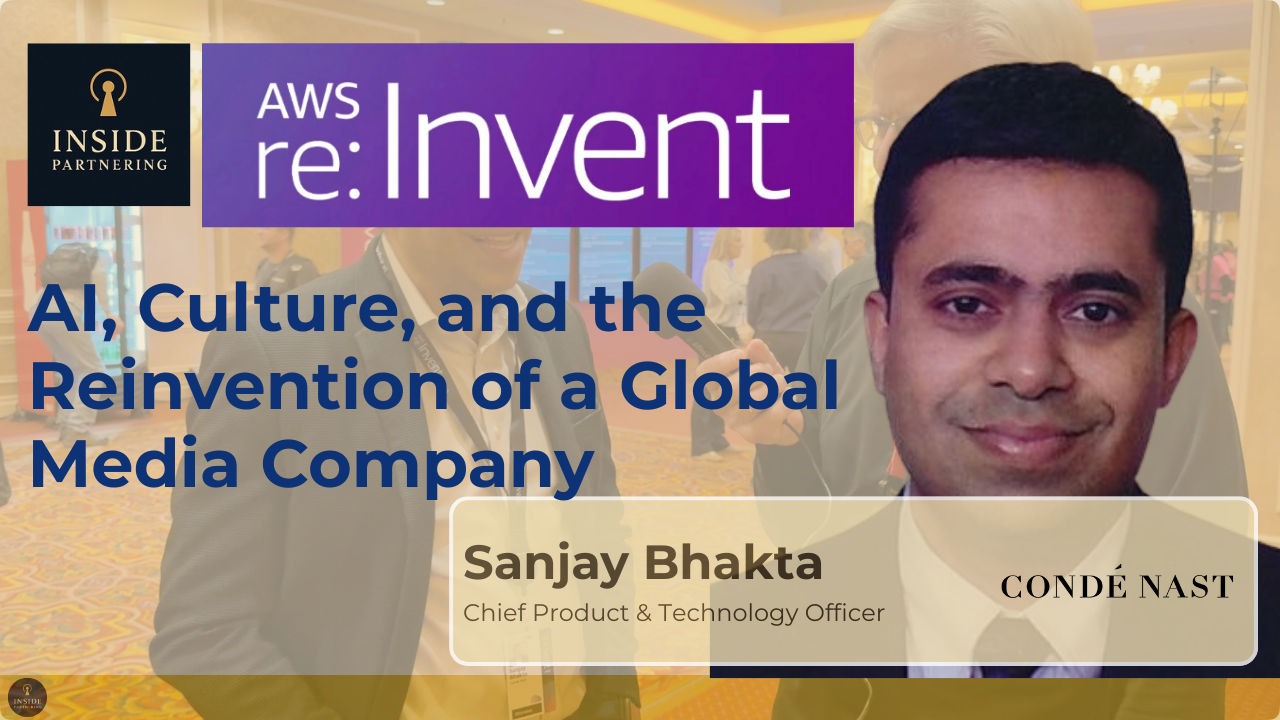
I sat down with Sanjay Bhakta, Chief Product and Technology Officer at Condé Nast, live at Amazon Web Services (AWS) re:Invent, to explore that exact question.
The story he shared is one of the most impressive digital transformations happening in media today.
Sanjay stepped into the company as its first CPTO with a bold mandate - unify 13 markets, nine languages, and dozens of tech stacks into a single global platform that supports brands like Vogue, The New Yorker, GQ Magazine, Vanity Fair, and WIRED.
One of my favorite moments:
“We wanted to bring everything into one global consolidated platform so we could innovate faster and deliver content across markets almost instantly.”
We talked about:
✅ How AWS helped reduce infrastructure cost and accelerate global deployment
✅ Why AWS Marketplace speeds vendor onboarding and increases ROI
✅ How AI is transforming both engineering (code generation, testing, deployment) and customer experiences (personalization, recommendations, smart recipes, image search)
✅ What it takes to preserve each brand’s unique identity while running on a unified platform
✅ Why vectorizing tens of millions of images and articles is Condé Nast’s next major frontier
Another powerful quote:
“Our next challenge is to make our entire archive easily accessible for LLMs in real time.”
Sanjay’s perspective is a masterclass in modern engineering leadership, cloud scale, and AI adoption.
Thank you Sanjay for taking time with us at AWS re:Invent to share your journey and powerful insights!
Full interview here on Substack:
Podcast
Guest

Sanjay Bhakta
Digital Media & Technology executive with over 20 years of industry experience leading large-scale engineering organizations in the areas of Media & Entertainment, Digital Publishing, Internet & Broadband, Mobile & IPTV Application Development, Corporate Information Technology, MIS & Shared Services. Held several executive roles as Senior Vice President Platform & Product Engineering at Pearson, Vice President Media Technology at HBO, General Manager Enterprise Architecture at AT&T, Senior Technical Director Internet & Broadband at SBC Communications and Director of Engineering at Prodigy Internet.

Episode Transcript
Sanjay Bhakta
===
[00:00:00] Sanjay Bhakta: It makes it really easy to onboard a partner when you're going through the Marketplace. And also we know that, AWS stands behind it and, there are other people on AWS who are using them. So they do help in making, our decisions faster and help us onboard these vendors and basically get things out to market fast.
[00:00:16] Chip Rodgers: Sanjay, how do you think about AI in terms of applying it to internally for your, the development organization, engineering and, DevOps and all that versus the customer experience or maybe a little bit of both, or how do you balance the two?
[00:00:32] Sanjay Bhakta: Yeah, we're actually doing both. We, early days we focused a lot on internal use cases.
[00:00:41] Chip Rodgers: Hey everyone, Chip Rodgers. Welcome back to another episode of Inside Partnering and we are here, it's actually day one, I think officially day one here at re:Invent. And it's been busy.
[00:00:54] Sanjay Bhakta: Yeah, it has been very busy. I only arrived late last night, so I didn't even have time to collect my badge until this [00:01:00] morning. So it's been a bit tactic for sure.
[00:01:01] Chip Rodgers: For sure. Hectic. Yeah. I had a day to to, to acclimate. So you're,
[00:01:06] Sanjay Bhakta: you're, it's,
[00:01:07] Chip Rodgers: Tough coming from
[00:01:07] Sanjay Bhakta: the East coast. It's always, a little bit of a challenge with the time zone.
[00:01:10] And then I have to head back tomorrow night, so it's very tight.
[00:01:13] Chip Rodgers: Very, it's a quick turnaround. Yes. Yeah. I'm so excited to be joined by Sanjay Bhakta. Sanjay. Sanjay just really excited to talk to you. Sanjay is Chief Product and Technology Officer at Conde Nast. And big role.
[00:01:26] You have a lot a lot under your purview and I think it's a fairly recent, maybe in the last four or five years that it's really been put in place. And just love to hear about, maybe we start there and just talk a little bit about your role and the things that you and your team are are up to these days.
[00:01:43] Sanjay Bhakta: Yeah, sure. As you pointed out, the Chief Product and Technology Officer role was something that was put in when I came in. I was the, I'm the first CPTO at Conde Nast. The goal was really to bring product and engineering closer together, rather than two separate entities.
[00:01:58] And then over a period of time, after [00:02:00] a year or so after I started, we brought data in as well. And then I also have all of the enterprise technology. So pretty much everything tech, starting with desktop, all the way to our customer products and data, everything comes under my purview.
[00:02:12] The so our journey at Conde Nast has been interesting. I'm gonna talk about it tomorrow in our keynote, but we've been on a major transformation journey as we are 115 year old company. And when I started we used to operate as, 13 separate markets, and each with its own CEO, each with its own tech stack.
[00:02:31] And we had multiple brands in each market. We were supporting nine different languages. The goal was really to bring everything together into one global consolidated platform for various reasons. One was, efficiency. Second was really allowing our editorial teams to collaborate really faster and better, faster content delivery.
[00:02:49] And and last but not the least, we wanted to rationalize our technology as they get everything in the cloud. None of our markets outside the US were on public cloud at the time. And also it [00:03:00] allows us to roll out features now faster. We build something, we can roll it out across brands, across markets almost instantaneously.
[00:03:07] So that was the big mission for us coming into, into this role. That was like the first job, really. Yeah.
[00:03:13] Chip Rodgers: And I could see, it's really interesting all the reasons that you just described. I could even see, you talked about editorial, it would give more flexibility for the editorial teams to be able to move from one to the other and just just step into the job.
[00:03:25] Sanjay Bhakta: Yeah, it does. Every editorial team when I started was using different tools. We had different CMSs. There was. Content sharing was extremely difficult and hard, very manual. But now with this, all of them being in the same CMS syndication is a snap. Any market can go in and look at a article and, we like it, we want to syndicate it, and we have an AI based translation into the local language.
[00:03:48] It does about probably 90 plus percent of the job, and then the editors of course go in and make their edits. But it has really helped us drive our syndication volumes. Significantly higher than where we [00:04:00] were. And we can syndicate almost in near real time. As soon as our content is published in one market, we can immediately syndicate it into others, so there's a lot of cross syndication that happens.
[00:04:10] The data looks pretty interesting.
[00:04:11] Chip Rodgers: That's amazing. Yeah. That's really interesting. I wonder how because each of the properties has its own brand and so the, but the platform, so single platform. But how are you allowing each of the brands to tell their own story.
[00:04:25] Sanjay Bhakta: Yeah. Brand expression has been a very crucial factor for us. So we are not trying to do a one size fits all. We want each brand to come out and express themselves their own branding, their own look and feel, and their own voice. So that was one of the fundamental premises of how we have designed our CMS and our front end system.
[00:04:43] We, all of our stack today is proprietary. Our CMS and our front end page generation is all built in-house. Yes. It does become challenging sometimes when you have to build bespoke things for each brand. We try not to build bespoke capabilities. We try to build as many [00:05:00] capabilities as possible that are reusable across brands, but sometimes we do have to make exceptions.
[00:05:04] Certain brands, like for example, games started with just the New Yorker. Now slowly, other brands are starting to adopt. And games. Everybody loves games. Yeah, exactly. Exactly. So I think we are, we are, we've done a good job there. So it does, so that has really been key for us, from a functionality standpoint, we want reusable functionality that we can deploy everywhere, but at the same time, the brand expression has to be unique, specific to that particular brand.
[00:05:27] Chip Rodgers: It's interesting. So I, it sounds like it's really delivering a better customer experience, end customer, consumer experience, but also probably at a lower cost as well.
[00:05:36] Sanjay Bhakta: Yeah, definitely. I think moving to public cloud and getting out of the multiple data centers we had and on-prem has certainly helped drive a lot of cost out from a, from an infrastructure standpoint.
[00:05:47] And it is also, I think the other thing that allow, it allows us to do is really innovate faster and scale up quickly, which was hard when you're on-prem, with cloud, you can. Really scale things up. You have the ability to test very quickly [00:06:00] and fail quickly, and do try other things. At the same time, you gotta be careful about cost because most times you think it's free, but it's not.
[00:06:08] Chip Rodgers: Oh, that's right. Talk a little bit about as you are deploying technology and you've recently gone through a migration to, with AWS to the AWS platform. Talk a little bit about that process and the decision to work with AWS
[00:06:24] Sanjay Bhakta: Yeah, when to be honest, when I started in early 2020, we had some for estate in AWS already in the us not so much in the international markets.
[00:06:33] At the time, to be honest, I think AWS was ahead of GCP or Microsoft Azure at the time, in terms of features. And since we were already on AWS partially and we had, existing knowledge within the, within our engineering organization of how to build and run infrastructure in AWS that was a big deciding factor.
[00:06:51] And also from a feature standpoint, Amazon was rolling out features much faster than others. And also, our agreement is at our parent company [00:07:00] level. So we have several companies within advanced publications and everyone is now on Amazon. So we get economies of scale as well. Sure.
[00:07:07] Being with Amazon. And of course, I think the other thing is Amazon has a pretty extensive marketplace. So we have a certain committed spend annually, and it helps us to partner with people who are in the marketplace, vendors who are in the marketplace. One, it, we know that it integrates very well with their existing AWS stack, and secondly, it helps, also helps us with our committed spend and also helps us get a much better overall return on investment.
[00:07:31] Yeah.
[00:07:32] Chip Rodgers: Yeah. That is a really nice. Capability that if you have committed spend, that you can actually buy technology in the marketplace.
[00:07:39] Sanjay Bhakta: Yes, that's right. So all of everything you buy in the marketplace counts against your overall spend. So that really helps. Yeah.
[00:07:45] Chip Rodgers: Along that vein, talk a little bit about with AWS has an extensive ecosystem of partners as well.
[00:07:51] How much was that a little bit on the Marketplace? How much was that in in your thinking through the decision process as well?
[00:07:58] Sanjay Bhakta: Yeah, I think early on, I don't know if [00:08:00] that, I don't believe, or I don't think that was the biggest factor that whether some companies in the marketplace or not.
[00:08:06] I think our biggest decision point was how well do they integrate into our existing stack within AWS for example, we are a huge Databricks customer and we use them extensively. And we had a direct contract with Databricks not through the marketplace. And because we signed it several years ago, and the big decision to go with Databricks was their seamless integration into our, existing compute storage and also activation that you have in AWS.
[00:08:31] So that was the biggest deciding factor. We have several others vendors like Snowplow, and others, that we use within AWS. Some of them through the marketplace, not all of them through the marketplace, but we are moving more and more into the marketplace.
[00:08:45] Again, I think it makes overall sense for us from a spend standpoint.
[00:08:49] Chip Rodgers: Yeah. Yeah. So the technology integration, so you're putting together solutions that are obviously AWS, but then also you have partners that are bringing capabilities in, [00:09:00] but it's still deployed on the AWS platform, correct? That's right.
[00:09:03] Sanjay Bhakta: Yeah. And it It makes it really easy to onboard a partner when you're going through the Marketplace. And also we know that, AWS stands behind it and, there are other people on AWS who are using them. So they do help in making, our decisions faster and help us onboard these vendors and basically get things out to market fast.
[00:09:20] Chip Rodgers: Yeah. Yeah. Congratulations on, it's been a five year journey and it sounds like things are going really well with bring, putting that new platform in place.
[00:09:29] Sanjay Bhakta: Yeah, it is. I think so far so good. Now we have different challenges with AI, but the good news is that we've been doing data science and machine learning at Conde for several years now.
[00:09:38] We were not on Databricks before, we were using GCP and Hadoop and a number of other platforms and stacks, but now we are completely on, on Databricks, and that has really helped us scale up the number of models that we build and train and run in production. Yeah. So our next challenge really for next year is to figure out how do we basically vectorize all of the content we have, just in terms of [00:10:00] images.
[00:10:00] We have tens of millions of images in our archive. How do we take our entire archive, make it monetizable, vectorize all of our content and make it easily accessible for LLMs in real time. So that's a different new challenge for next year. Yeah.
[00:10:12] Chip Rodgers: Always new challenges. Yes, absolutely.
[00:10:15] Sanjay, how do you think about AI and maybe the answer is both, but are you thinking about it in terms of. The applying it to internally for your, the development organization, engineering and, DevOps and all that versus the customer experience or maybe a little bit of both, or how do you balance the two?
[00:10:33] Sanjay Bhakta: Yeah, we're actually doing both. We, early days we focused a lot on internal use cases. We use it extensively within our engineering organization for code generation testing. Deployment, various use cases, and it has really been super helpful. We tested a lot of tools and, it took us time to, to find the right ones.
[00:10:50] There's a lot out there as there's hundreds of startups on a daily basis. Exactly. And
[00:10:54] Chip Rodgers: more and more coming every day.
[00:10:55] Sanjay Bhakta: Yeah. So picking the right tool I think is the biggest challenge honestly for [00:11:00] solving any use case using ai. I think that's where the Amazon marketplace also helps to a large extent.
[00:11:05] And then we have now deployed AI for several internal use cases as well. Many of the use cases that we are deployed internally are based on Bedrock and generative AI. We have a we just recently launched a contracts management and rights clearance platform. It used to take us weeks to clear rights for a particular asset Editorial had to go through our business affairs team, lawyers had to pull up the contract. That may have been, I don't know, God knows how old. Yeah. Now that all the contracts are in the system, it's almost instantaneously. That's amazing. Yeah. Yeah. And that's one. And for, from a customer facing standpoint, we do a lot with recommendations, personalization, personalized newsletters, we have our dynamic renewal pricing.
[00:11:44] We do a segmentation, propensity modeling. So we have. Probably a dozen different machine learning models that we have deployed from a customer facing use case standpoint. And most recently we partnered with OpenAI to launch in smart recipe application [00:12:00] that's AI based on Bon Appetite, which allows people to do natural language search and also be able to alter recipes to their taste.
[00:12:06] If you're a vegan or a vegetarian, you could ask, the recipe to be converted to your product. You've shown certain kinds of. Yeah. Yeah. And you could take an existing recipe and you can, you can ask for the recipe to be turned, into vegan or without a particular ingredient and so on.
[00:12:18] So we are still working, there's a number of use cases that we are still working on, Vogue image search is a really good one. We launched a Vogue app about a year and a half ago. And we have tens of millions of runway images in our archive, and finding something is extremely hard.
[00:12:31] Yeah. So now you can go in and search through our entire archive using natural language and be able to find what you're looking for, in no time. Yeah.
[00:12:39] Chip Rodgers: That's fantastic. Sanjay. I really appreciate you again. Congratulations. It's really some amazing thank you both for the, for consumers, but also internally really some really great technology you've, yeah.
[00:12:50] You and your team have deployed, so congrats.
[00:12:52] Sanjay Bhakta: Yeah, absolutely. Absolutely. I think I'm very blessed to have a fantastic team. All the credit goes to them. I can just stand here and talk to you while they do all of the heavy [00:13:00] lifting and the hard work. But yes, a lot of effort has gone in and we are hyperfocused on what we can do next.
[00:13:05] It's
[00:13:06] Chip Rodgers: fantastic. And good luck on your keynote presentation tomorrow. Yeah. Exciting. So Sanjay, thank you for joining. Thank you very much and thank you all for joining another episode of Inside Partnering and just remember to like, share and subscribe and we'll see you next time. Thanks everybody.
[00:13:22] Thanks Sanjay.
[00:13:23] Sanjay Bhakta: Thank you.
[00:13:24]

Chip Rodgers
🚀 CMO | Chief Partner Officer | B2B SaaS Growth & GTM Leader | Ecosystem Strategy | Demand Gen | Podcast Host 🎙


.png)