Episode Overview
When you think about partnerships between two global tech giants, few are as powerful as AWS and Salesforce.
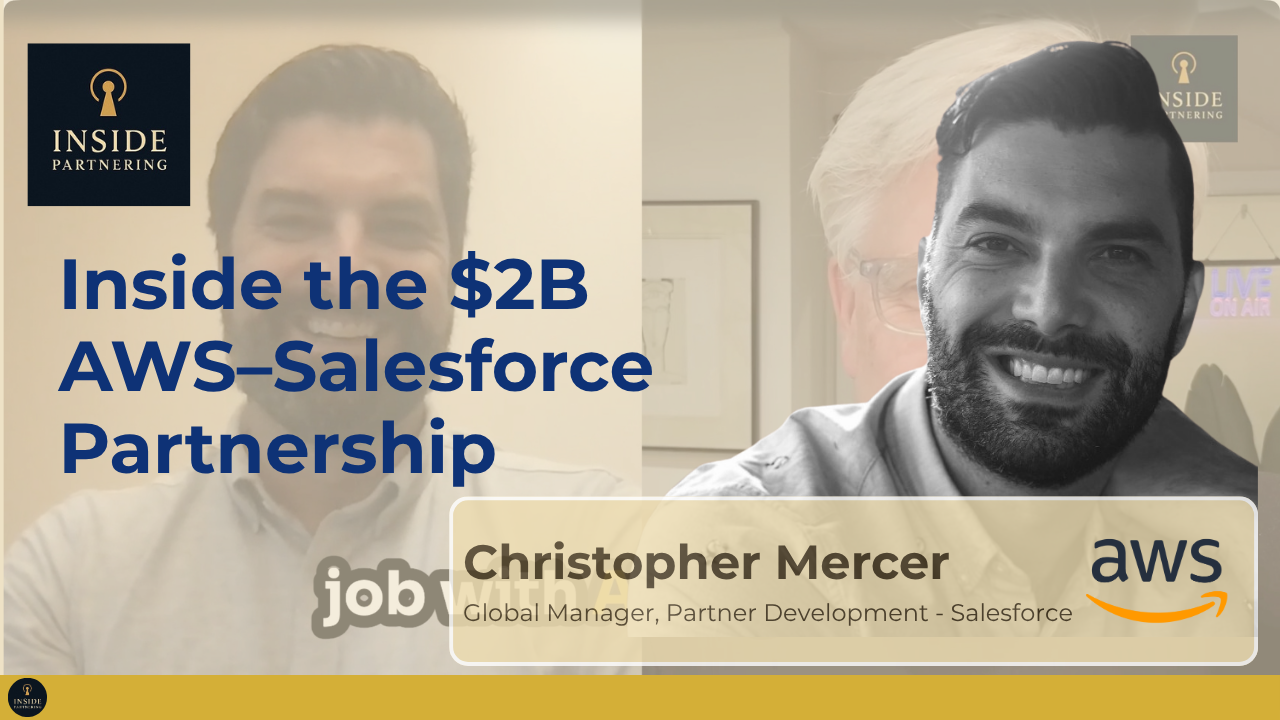
In this episode of Inside Partnering, I sat down with Christopher Mercer, Global Manager of Partner Development for Salesforce at AWS. Christopher’s story is a rare one: he started his career at Salesforce, spent nearly a decade there, and then transitioned to AWS - where he now manages the very partnership between those two companies.
It’s a unique vantage point that gives him insight into both cultures, sales motions, and the intricate web of customer needs that drive collaboration at scale.
Inside Partnering is a reader-supported publication. To receive new posts and support my work, consider becoming a free or paid subscriber.
The Perfect Intersection of Two Worlds
Christopher calls his journey “a story of lucky intersections.”
He first joined Salesforce right out of school as an inbound sales rep, then later became a Salesforce system administrator for a healthcare company - an experience that shaped his understanding of how Salesforce’s platform was used in real-world business workflows.
Years later, after joining AWS, a colleague noticed his Salesforce background and asked if he’d be interested in leading the Salesforce partnership.
“It was the perfect cross-section all over again,” he said. “I’d been on both sides—and suddenly had the chance to connect the dots.”
Three Pillars of the Partnership
Christopher breaks down the AWS–Salesforce relationship into three main areas:
- Product Development – How each company’s technology complements the other.
- Example: customers building on AWS who want to connect data from Redshift or S3 into Salesforce Data Cloud, enabling richer customer insights and AI capabilities through Agentforce and Amazon Bedrock.
- Co-Marketing and Co-Sell – Educating both Salesforce and AWS sellers on how to jointly tell the story.
- As Christopher puts it, “Sometimes it’s as simple as asking a customer, ‘Do you use Salesforce and AWS?’ If the answer’s yes, there’s a great conversation to be had.”
- Customer Enablement – Empowering GSIs and end-customers to bring both ecosystems together.
- Many global SIs have separate AWS and Salesforce practices; the partnership aims to bridge those silos and unlock new value through integration.
From Product Integration to Marketplace Momentum
The partnership’s momentum accelerated with the Strategic Collaboration Agreement (SCA) announced in 2023. Within a year, Salesforce reached over $2 billion in AWS Marketplace transactions - a remarkable achievement driven by cross-functional teamwork and customer demand.
But it wasn’t just about procurement efficiency.
Marketplace opened the door for deeper collaboration. Salesforce sellers found new opportunities to engage AWS teams, while customers benefited from simplified purchasing and the ability to apply their AWS spend commitments to Salesforce products.
For AWS, it created a new path to co-sell opportunities and customer conversations around data, AI, and modernization.
The tech partner ecosystem is experiencing one of the most dramatic shifts in decades. Generative AI, agentic frameworks, and security innovations are reshaping how enterprises build, deploy, and consume software.
Co-Selling in the Age of AI
When Salesforce launched Agentforce, AWS saw an opening for meaningful technical collaboration.
Customers using Agentforce needed access to high-quality, first-party data, often residing in AWS data lakes or Redshift clusters.
That’s where co-selling became essential.
“Salesforce reps were hearing customers say, ‘Our data’s in AWS, can you connect us with our AWS rep?’” Mercer explained. “It was the perfect timing for our two teams to come together.”
The combination of AWS compute, AI services like Bedrock, and Salesforce’s CRM and Data Cloud created an end-to-end story for customers - from infrastructure to insight.
Listening to Customers Drives Innovation
A theme throughout the conversation was customer feedback as the true north.
From early success with Service Cloud Voice (built on Amazon Connect) to the latest integrations with Tableau and Data Cloud, many innovations came directly from customer requests.
“Customers told us they loved both Service Cloud and Amazon Connect,” Mercer said. “They asked us to figure out how to bring them together—and that became Service Cloud Voice, now Agentforce Voice.”
This customer-driven model also extends to roadmap discussions. AWS and Salesforce teams regularly meet with joint customers to identify new integration opportunities and push the boundaries of what’s possible.
The Strategic Collaboration Agreement: Lessons for ISVs
Every ISV dreams of signing a Strategic Collaboration Agreement (SCA) with AWS. Christopher described the process as a disciplined alignment exercise across three questions:
- How will it work for AWS’s field?
- How will it work for Salesforce’s field?
- How will it work for the customer?
“If it doesn’t work in all three areas,” Mercer said, “it doesn’t matter how good your solution is - it has to make sense for the people who sell it and the people who use it.”
That pragmatic focus has helped keep the partnership aligned and durable. Almost everyone who worked on the initial SCA in 2023 is still actively engaged today.
Looking Ahead
As both companies continue to innovate, Christopher’s job remains as dynamic as ever.
“Just when we think we have something figured out,” he laughed, “AWS or Salesforce comes out with a new product - and we have to adapt all over again.”
For Mercer, that’s exactly what makes the partnership exciting. “When you bring together two companies like this - each moving fast and pushing boundaries - it forces everyone to think bigger.”
💡 Key Takeaway
The AWS–Salesforce alliance shows what’s possible when two cloud leaders unite around customer value.
It’s not just co-selling - it’s co-building, co-innovating, and continuously co-adapting.
Podcast
Guest

Christopher Mercer
Experienced in working with enterprise clients and leading teams on implementing new technologies to improve business performance and customer outcomes.

Episode Transcript
Christopher_Mercer
===
Christopher Mercer: [00:00:00] What makes it really interesting is, just when we think we have something figured out, right either. We come out, AWS comes up with a new product, or Salesforce comes up with a new product, right? And it keeps us on our toes, right? And in that moment, customers are saying, Hey, they just came up with this.
What does that mean? And, we have to try to think about what does that mean for the partnership and how do we adapt to what that actually is really, how do we adapt to this new method that people are building on or what's, with the newest product,
Chip Rodgers: Maybe that's a good transition to the co-sell process. Talk a little bit about that co-sell process between AWS and Salesforce.
Christopher Mercer: Yeah. It's been yeah, it's been really interesting. I think in the beginning, if you go back,
Chip Rodgers: Hey everyone. Welcome back to another episode of Inside Partnering Chip Rodgers here. And I am so excited to be joined by Christopher Mercer. Christopher, welcome.
Christopher Mercer: Yeah, it is so great to make this happen. I've been really looking forward to this. And then I [00:01:00] know you and I were just talking about the fact that, there's gonna be so many great AWS people that are coming up. I saw the lineup. So happy to be a part of that group of people.
Chip Rodgers: Yeah. Fantastic. And we were when we were first talking about this, we were gonna do it. You were gonna be here in San Francisco. Actually, we were gonna do it.
Christopher Mercer: Yeah.
Chip Rodgers: SFO28 and and then, as things happen, of course it's you've got called into meetings in New York and couldn't be here.
So we're doing it virtually today.
Christopher Mercer: Yeah. No, I appreciate you making the change. I'll try to make up for it. I know there's enough like Salesforce World Tours and AWS summits that I'm sure we'll find a way to get down there to SO 28. I find myself there quite a bit. But yeah, thanks so much for accommodating. I appreciate it.
Chip Rodgers: For sure. No. As I said, I'm really excited to have Christopher join, and Christopher has a great job with AWS you're, and it fits really well with your background. You were many years, I think eight years with with Salesforce, and now. Six, seven years at AWS and your role is you're the, lead [00:02:00] for managing the Salesforce relationship.
So big job.
Christopher Mercer: Yeah, it's, it's just so one of these things where it just, it could not be more perfect. My first job out of school was at Salesforce. I was a I, I joke that I've done. Almost every job, pretty much I was a I started off as an inbound sales rep for Salesforce right outta school.
And, I actually ended up leaving for a brief period of time after that job to pursue more system administration roles. So I became a Salesforce system administrator, and so I worked in-house at a healthcare company and I didn't really know what I was doing at that point in time in my life.
And then all of a sudden, as luck would have it. Salesforce said, Hey, we're starting a healthcare division. And I was like, whoa. That's an amazing cross section. Because I left to become a system administrator at a healthcare company with Salesforce. And okay, that's pretty lucky that the sort of healthcare division ended up doing that.
And then I felt like I got another round of luck because I was working at AWS and someone said, [00:03:00] Hey, I noticed that you have some Salesforce experience. I was like, yeah, no, I've worked there for a long time. 'cause I ca after that doing this administrator the healthcare team was like, I think it was about eight years I was there, roughly.
Pretty close too. And I, they said we want someone to run the Salesforce partnership. And I was like, oh, this is. Like all over again, this perfect match of AWS and Salesforce coming together. So I've just been so lucky that, throughout my career that these really interesting two things come together at the right time.
Like First Healthcare and Salesforce, and then now like AWS and Salesforce. So it's just been great. I've been, really lucky to have the ability to do that
Chip Rodgers: That's awesome. I think it's I was with SAP for a lot of years and in the partnership, in partnership roles, it was funny to see, people were, managing the, Accenture relationship or the Deloitte relationship, or EY relationship or whatever. And they do that for, 2, 3, 5 years.
And then it was like, wait a minute. Then they flip [00:04:00] over
Christopher Mercer: Yeah.
Chip Rodgers: Oh, go work for Accenture. And then, because, a lot of re of partnerships is about knowing the internal organization and being able to, pick up the phone and, have people answer things like that.
Christopher Mercer: Yeah. You're like, oh, I think that person still might work there, but at least you know that division, right? So much of each organization is just knowing where to go. And so just at least knowing it being at Salesforce basically first job, and so long like culturally what's important to them.
Like also what, and I think that was the one thing that I really liked so much is that I had sold for Salesforce, I had sold for AWS and then I saw this really? Obvious middle. Like having kind of that two side where, I went to, Salesforce, I was just so focused on this line of business, kind of sales service, marketing type role.
And then AWS, it was a bit more of a shift where I was focusing much more on, I'd say more, a little bit more back office type, like people that are doing more building and technical development and [00:05:00] then. I saw this like really interesting pattern emerging where I'd be at AWS as a seller and I'd be like who are you building this for?
What are you doing? And they're like, oh yeah, someone in marketing needs me to build this data lake because I gotta get this data up and over to them. And I was like, I think they use Salesforce, don't they? And so it was like this really interesting kind of where I was able to do that in my sales role.
And then when I got into the actual partner role, I started seeing that Hey, people are building these things to ultimately, at some point get sort of customer information over it. So it was trying to find that middle. And yeah, I just, I think I just really saw a unique opportunity and I didn't even know that it existed until someone brought it to me, which was great.
Yeah.
Chip Rodgers: that's awesome. That's terrific. And you're, just again, in terms of your background and, grew up in the Toronto area and and now based in New York, and I'm sure you're quite happy with last night's
Christopher Mercer: I am. Yeah, I was and my accent will probably give me away. It's only a few words here and there, but they're obvious. But yeah, I, I was lucky enough to be, [00:06:00] about I was 10 years old when, the Blue Jays won in world Series in 1992 and then won in 93.
And now I live in New York which. I do get in a little bit of trouble from friends and family when I do go to the Yankees games. And I let them know that I can't wear Blue Jays apparel, when they're playing the White Sox. It just doesn't make sense. And I still want to go see the Yankees, but I think Yeah.
But in this case, yeah, I, I'm very excited for the Blue Jays. Yeah. I was very happy with the outcome last night,
Chip Rodgers: Yeah. Yeah. I we watched the the game the night before, and I actually, we, I went all the way through 17 innings. It was midnight, and I'm like, okay.
Christopher Mercer: Yeah. You're like, how big of a fan am I that I can do this? But yeah, you, yeah, you have to, people were coming out at three in the morning and look like, I think, regardless. I think more people, for whatever reason, because of this series, more people I talked to are, watching baseball than ever before, so it's just, yeah, it's exciting for the city.
It was, I feel bad because it was exciting for New York for a brief period, there's always next year, so Yeah.
Chip Rodgers: Yeah. [00:07:00] So anyway should we talk about partnerships?
Christopher Mercer: Sure. Let's do it. Yeah. Yeah. No, for sure. Yeah,
Chip Rodgers: Yeah. Let's start with, why don't we just start, Christopher with your, just your role, what it is that you're, doing with with Salesforce. Obviously Salesforce signed a Strategic Collaboration Agreement with a AWS couple, think in 2023.
And man, you guys have been on a tear, I think over $2 billion in revenue on the marketplace, and just a lot going on. So just tell us a little bit about the, the landscape of what you're what you're up to these days.
Christopher Mercer: Yeah. So yeah, it's come a, I would say it's come a long way in a short time, and I think there's a lot of reasons for that. And first and foremost, I think, honestly and it is true, is that the, I am so lucky, for not only the team that I work with at AWS.
But also the team that I work with at Salesforce it is just phenomenal. You rarely get situations where you just gel so well, with the people that you're working with. [00:08:00] And yeah it's just been great, and also, a testament is, as you mentioned in 2023, when we, we started working on that in early 23, and, we're coming up to 26.
Almost every single person that was involved in the beginning of that partnership is still with it today. And still very convicted on on what that looks like. And I think a lot of it's because they see what the potential is, right? So getting back to what's the responsibility?
I think the responsibility is around three main aspects. Like one is the product development side, right? I talked before, you know about, hey, I saw an opportunity when I was working in more of the back office and people were saying, Hey, what are you building? Hey, I wanna get that over to Salesforce, right?
It's okay, we should go and work with companies that have invested heavily in building things on data lakes and data warehouses like, with AWS Redshift and S3 and say, Hey, I know you've spent a lot of time getting that data, into, AWS, are you using Salesforce?
If the answer is yes, is that [00:09:00] data beneficial? Could you be able to bring that data to your users? And so that's a big part of what, we've been working on, is try to make that that adjustment for people, especially as Salesforce has their data cloud product, and then on top of the Data Cloud product, they're running their Agent Force product.
So it's hey, if you're gonna run Agent Force and you want to get insights using ai leveraging, Amazon Bedrock which is running Anthropic. Let's get all the data we can in there. Let's make it as good as we possibly can. And so that's a big part of the job, and I work with a lot of really great technical individuals within AWS and at Salesforce to help make that happen for customers.
And then the other big part is really the marketing and the co-sell of it, right? Is, how do we let both Salesforce sellers and AWS sellers know that when they come in front of their customer, they can tell that story. So I think, for Salesforce sellers and AWS Sellers I just make it really, simple.
It was almost like laughably simple. I was at a. I was at a conference at Dreamforce and I said, really all you have to do is just say to a [00:10:00] customer, and do you have Salesforce and do you have AWS and if so, let's have a conversation, which sounds extremely simple, right? But there, the reality is and it's so obvious when you're in it, but it's not obvious when you're outside of it, is that, GSI organizations, right?
They generally have an AWS practice. And they have a Salesforce practice, right? And what we're trying to do is we're trying to say, Hey, let's bring it together. But traditionally they've been separate. And so what we're trying to break down those walls and try to say, Hey, like there's a benefit here. And that's why we say, to start really simple Hey, do you have AWS?
Okay, what do you use it for? Like you put in data. Are you building applications? What does that look like? And okay, what are you using Salesforce for? Okay. What does that look like? There's always gonna be a middle. But it's still new, right? And so I think that's what a lot of my time is spent doing is educating around that.
'cause there's still so many possible use cases that [00:11:00] are out there, right? Of where our two companies can come together. But it's just, we're just scratching the surface. So those are the main things. It's like creating the products that are gonna make it easy for people to have that conversation.
Hey, I do have both. What can I do? And then, so we wanna get that message out there. That's what I'm spending most of the time doing.
Chip Rodgers: Yeah. Yeah. So are you, are, does that mean you're and maybe it's all the above, but you, are you working with, I mean with customers and partners and the product teams as well on pulling all those things together and saying, Hey, I'm hearing this in the market, and are we working on something like this?
Christopher Mercer: For sure. And I think what makes it really interesting is, just when we think we have something figured out, right either. We come out, AWS comes up with a new product, or Salesforce comes up with a new product, right? And it keeps us on our toes, right? And in that moment, customers are saying, Hey, they just came up with this.
What does that mean? And, we have to try to think about what does that mean for the [00:12:00] partnership and how do we adapt to what that actually is really, how do we adapt to this new method that people are building on or what's, with the newest product, for example like when Salesforce came out with Agent Force.
Luckily we already had a lot of integrations that were built on there, that we could use and leverage with AWS in terms of the story of how do we get data into their data cloud and then, build that up, right? So that, that was, that was one of those things where, you know, that makes it hard.
But at the same time, we are always trying to get a little bit ahead of it. And a lot of that is, like you said, is meeting with the customers, right? So we meet with customers and they say, Hey, do you guys have a solution for this? What's on the roadmap? And we've been lucky to have a lot of great customers this year at Dreamforce.
We actually featured quite a few customers more than we ever had, really leading discussions. And that's really what we want to do going forward. For example, we had customer references in our AWS booth from F1 is one that I'll mention [00:13:00] and with they're saying, Hey, these are the benefits that we got from bringing together both Salesforce and AWS.
And that to me is like what I want to do more of, especially in these Gen AI type scenarios where it could be anything, right? It's like it's not just a single purpose tool. You can use it for all kinds of things. So the more customers that are willing to put their hands up and say, Hey, this is what we used it for.
And then I can go back to those customers and say, you guys are clearly early adopters. What are the things that are slowing you down and where can we build it? And then work with Salesforce and AWS both together to create that next thing customers want.
Chip Rodgers: Yeah. Yeah. What how much flexibility is there?
Christopher Mercer: Yeah. Up,
Chip Rodgers: because. AWS has a product roadmap. Salesforce has a product roadmap. And are you able to influence that? Or how does that and I assume if you bring a, a customer that's, or multiple customers that are then that has, that speaks a lot to the [00:14:00] product teams.
Christopher Mercer: For sure. I think really customer demand really is like really what leads, right? And I and I think, we have been really good. I think of being a little bit ahead of the curve, I think in terms some of our releases, I think early on we had this idea of bring your own model, right?
So the idea that you could take models that you build in AWS on SageMaker and you can bring that into Salesforce, right? And that was something that, we'd heard from customers where they said, Hey, we've already spent all this time building models within AWS and, but. We want, we don't wanna have to, recreate that.
We're like, don't worry, you don't have to, you can bring that right into Salesforce. And then that was a direct result of customer conversations. So I I will say I think it's pretty influential. And also I think one of the reasons, what I like about Amazon is. There really is this culture of coming up with new ideas.
For people that are familiar with Amazon, some of the core leadership principles that they adhere to. One of them is this think big principle, right? Hey, if you've got a really great idea, let's hear it. And I [00:15:00] think we've been able to do that a number of different times with Salesforce throughout the partnership process to come up with some of those things. Yeah.
Let's talk about marketplace a little and just, clearly it's been a huge success. And AWS marketplace itself has been an incredible, success. And it seems like Matt Y is every week is announcing new capabilities, on LinkedIn and, but, and then, so Salesforce has also really taken advantage of that.
You don't get to $2 billion. Without, so talk, tell, talk a little bit about that journey and as you said, it's been quick, it's been really fast.
Yeah, I think it has really taken off quite a bit, I think. Yeah. You mentioned Matt Y. Credit, to, him and ev everything that he's done there. He is been a huge supporter of all the work that we do. I think, it goes back to. I think we knew what our challenges were going to be early on in.
It's very similar to what I just said about [00:16:00] most GSIs and SIs having a very separate world for AWS in a very separate world for Salesforce, and we knew that was going to also present itself within. Different organizations where they were going to have a Salesforce department for the most part, and they would have a AWS department.
And one of the great things about Marketplace is the benefits that it gives you by purchasing Salesforce through the marketplace. But I think one of the things that we anticipated is that sometimes the people that are purchasing Salesforce may not even know what AWS is, right? And so we had to really make sure that we did a lot of enablement on, hey, if you're speaking to someone about marketplace, like what are some of the things that you should let them know?
And to the point where, we had people, ready to go on our side for sales calls and things like that. Just, especially in the beginning to help educate customers who don't know what Amazon is. And we would say, Hey, this is the part [00:17:00] you should probably go talk to. Because they'll be really disappointed if they find out that you could have put something in marketplace and you didn't. And at least try to have that conversation. So I think really where we where we did a good job was really bridging that gap within organizations. And to, a lot of it. Sure. Procurement at the end of the day, marketplace seems like a logical place to be there, also at the same time. Line of business owners and things like that, a lot of times, they just, they buy Salesforce, right? And it may go through procurement at some point, but if they don't bring it up, then you know, they may miss out.
And it may only be months later where somebody goes, Hey, did we not buy that through marketplace? And that's what the fear that we had, that conversation would come up made us make sure that like for every deal, we make sure that we really educate the line of business buyer. In all likelihood could have been buying Salesforce for 20 plus years.
N never hearing the word marketplace. So yeah, it's a big difference in terms of how to [00:18:00] purchase software, right? So
Chip Rodgers: I would think the Salesforce field team would really value that as well, right? It helps
Christopher Mercer: for sure.
Chip Rodgers: done. It's, it can free up budget with pre-commits and just the whole transaction process and currencies and all that. I would think that would be a big benefit to the Salesforce teams.
Christopher Mercer: Yeah, it's, it is a huge benefit to those teams. And I think the other benefit is that, a customer may come in at first because they wanna purchase a marketplace, right? But. It leads to some of these other conversations and things that I was talking about before, right? So for example a Salesforce seller may say, Hey AWS, I just worked with you on that marketplace deal.
That was great, but I'm wondering if you can help me out. Because the customer's telling me that they have all this information that they want to, they have an AWS, I'm not really sure, I'm not familiar what the products are, but they said it would be really valuable, to have that in Salesforce.
Can you help? Understand can you help with [00:19:00] that? And I think that's where we can really come together, right? It's sure. Like I love, the marketplace is a phenomenal part of our partnership, but ultimately, like the best payoff I, I have seen so far is really like at Dreamforce when our customers are talking like, yes, I purchased this on Marketplace and I also brought, critical data in from AWS to help into data Cloud.
And then I ran Agent Force on top of it and look at all the great insights. It helped me get more sales. Better service handling times, better marketing conversion rates and things like that. And that, I find it was, it's just like the first part and then it, they start building relationships together and they'll say, Hey, you know what?
We should bring this in front of the customer. Or, or, Hey, would you mind joining me on my sales call? So it's a really good, like earned trust internally, which ultimately only results in better outcomes for the customer, right? Because if they're a customer of both. It's pretty rare when you have two vendors coming together saying, Hey, we think we've got something for you here that would benefit you.
And [00:20:00] proactively and yeah. And they really appreciate that, which is great.
Chip Rodgers: Maybe that's a good transition to the co-sell process. 'cause you're talking about, building trust, building relationships. How has that worked, over the course of the partnership? 'cause it's so important, right? It's getting the teams together to talk about the joint value proposition and how do you how do they work?
Do they work together to grow their influence within the account and things like that. Maybe you know, somebody we know, some, talk a little bit about that co-sell process between AWS and Salesforce.
Christopher Mercer: Yeah. It's been yeah, it's been really interesting. I think one of the things that's really helped I think in the beginning, if you go back, I like when I was working in Salesforce, right? So I think that was maybe around 2006 to 2008 area. You look at what Salesforce had, at that time it was mostly focused around the core CRM sales application, right?
And then later on they added on the service components and things like that, right? But now [00:21:00] moving ahead. There's so much focus on Agent Force and data and being able to get as much data as possible that the co-sell really lent itself just perfectly at that moment. Because sales reps would say, they with Salesforce would say, Hey, you have agent force and the ability to run it on first party data, and the customer would say, oh, great.
That's great. We've been using that. You know what? We've actually got our data. It's in this application. I think it's on premise or something like that. And, but I don't know, like how do we connect to that? And some of those conversations really lent itself from them hearing about AWS and the, so we, we started getting more and more of these, Hey, could, can we connect to our AWS rep?
Can we ask our AWS rep a question? So it was like this perfect timing where Salesforce was asking us questions where we were really relevant. And where we can help them in terms of oh, maybe there's an application we can help them modernize and then we can bring that data in. So it's like a combination [00:22:00] of timing.
When we were doing Marketplace, as we were doing marketplace, Salesforce was also launching Agent Force, right? So it was like this perfect storm really, where it's
Sure, yes, you can make your purchase on Salesforce, but did you know. That there's also a bunch of other things that we can do as well.
It was like, it was just right at that moment. If you think back, I think it was right at, right in 24, around that time, right? It was when Agent Force was launching, so I think that's where the co-sell just became more prevalent. It was less about, Hey, yes, you could personal marketplace, tons of benefits there, but then it was just like a meatier co-sell because of the fact that.
We really played a role there from a technical perspective in helping each other out. And, in the same way Salesforce was able to take that data that we had in AWS and really translate it into a really great execution layer that people are already using. And just connecting that together and all of a sudden it's like really unlocks a whole bunch of value right.
That we didn't have before. Sure there was value there from. [00:23:00] AWS users, but then connecting that over to the Salesforce users really accelerated the value.
Chip Rodgers: and Salesforce also has, acquired a lot of companies, so you got the MuleSoft and Slack and all the other capabilities as well that are now in that toolkit that customers are.
Christopher Mercer: Yeah. And I think that's been a really interesting one as well, right? I think, Tableau, for example. It runs, you can run it on premise, but you can also run it on Tableau Cloud, which runs on AWS and I think there's like a lot of questions there. Hey, what's the value of of running this on AWS, right?
What do we get out of it? And then also, looking forward what are. Ways that I can use Tableau and ingesting AWS data into Tableau and things like that. We get, there's a lot of times we'll be in a meeting and we'll hear a question about something and we'll go, Hey that's a pretty good idea.
Maybe we should do that. Is that three customers asking? Is that one customer asking? That, that's a interesting thing is that we, when each company is constantly coming out with new products the customers are really the ones that tell you like.
The [00:24:00] scenarios, right? Because it's one thing to enable it, but it's like what do they actually want to do with that? And I think like one of the ones that has always been, and continually still is the one that leads right now is our first partnership that we actually did in which actually predates Marketplace, which is our call center solution, which is now it's called Agent Force Voice, but prior to that it was Service Cloud Voice, right?
And that's with using our Amazon Connect product. And taking the Amazon Connect product and then marrying it up with Service Cloud, right? So you're able to use our call center telephony with their product. And that was just an interesting one because customers were. Telling us all different, scenarios that they wanted to see within the IVR, but at the same time wanted to use the service capabilities of Salesforce.
And, there's been so many iterations. And like just recently at Dreamforce, there's even more announcements of enhancements we've been doing on that, which are a direct result of meeting with customers and all the service capabilities that are, [00:25:00] that customers are wanting, particularly with AI now too, right?
Seeing, how they're able to source knowledge and how to bring those things in using our AI models that we have hosted on Bedrock and how can they use that with Salesforce customers that have been using Amazon Connect and and using a service Cloud. The product is Service Cloud Voice.
Over a period of time we're always saying what's next? What else is coming? And. A lot of it is through these meetings that we have with customers that are, have been with us since the beginning, who are pushing us and pushing us to release new features.
Chip Rodgers: Yeah. Terrific. Terrific. What we talked a little bit at the beginning about the the Strategic Collaboration Agreement. Talk a little, to the extent that you can talk a little bit about that. I think it's something that, it's the holy grail for a lot of ISVs, they wanna, get in that club.
And how, talk a little bit about that process and what it has meant for both, Salesforce and AWS.
Christopher Mercer: Yeah, I can, without getting into specifics, I'll talk about the process. I think you [00:26:00] look at when it was done right in sorry, at the 2023 and up until that point, we had done some things, like I mentioned, the Service Cloud Voice product. We had already created that, right?
That was something that was just our customers were saying, Hey, I really like your I already use Service Cloud and I really like it and I really like Amazon Connect. How can you guys figure this out? And so we were doing that, but I think really what it was like, it was a moment where it's like, Hey, that was really cool what we just did there.
How many more really cool things are there that we could do, right? There's gotta be more than that. And I think that was really it, because once we started going with that and customers were really picking up on it, we were like, there's gotta be more to this, right? There's gotta be more to this partnership.
And so I think, it really just starts really, basically it's hey we gotta answer three questions, right? In order to make this thing work. And it's gonna be like, how is this gonna work for AWS? And that's, mostly we're talking about the field at that point, right?
If [00:27:00] we, how is it gonna work for the field on our side? How is it gonna work for your field? In terms of what would work for them and the suite of products that they have, and then ultimately how does it work for the customer, right? And then trying to figure out those three things.
And you have to win in all three of those areas, right? And if it doesn't work in one of those areas, then it doesn't matter how good you know your solution is or what you have, it's just, it's clunky. 'cause it doesn't work with, the account manager on the AWS side, or it doesn't work with the account manager on the Salesforce side.
So a lot of it was just sitting down and saying, okay, this is what is really important to us strategically right now, and at this time point in time, and this is what's really important to, Salesforce strategically at this point in time. And how do we bring those things together and that was the first step. Now, what's made it infinitely challenging is neither company took their foot off the gas on developing new products. We're, we're continually having to revisit what that roadmap is. But, it was a great starting point in 23 of just saying, okay, how do we address these things and.
Ultimately, [00:28:00] yeah, there's gonna be some areas where there's maybe some conflict, right? There's gonna be some areas where people will say, what happens if this happens? Or what happens if, you approach a customer with this? And we've already approached 'em with that. It's a challenge, right?
But I think, we really came up with a really good kind of rules of engagement and came up with a plan and a goal to, as you mentioned, the 2 billion number. That was something that we planned for, right? It was something that we wanted to to get to. And so I, I think it was, that was really the first step of sitting down and doing it.
And, I will say that again. We were very lucky in just the customer feedback on the Service Cloud Voice product. At the time I, it was just way more than I would've thought. It just I knew that it was a great product, but I had no idea that it was gonna take off that quickly.
And customers would just be I guess enthused about it by how quickly they could make changes that using other call center technology they told told me and told Salesforce would take them a long time. And so I think that really drove us to [00:29:00] do that strategic agreement because we're like, there has to be more to this partnership.
Like Salesforce, you have a ton more products than just Service Cloud and AWS You have a ton more products than just Amazon Connect. We've gotta figure this out. Okay.
Chip Rodgers: That's cool. Congrats.
Christopher Mercer: Yeah. Thank you. No, it's been really fun. Yeah, it's been great. Yeah. So
Chip Rodgers: Yeah. Christopher, thank you for spending some time and talking about the about your role and about the partnership between, Salesforce and AWS and, we're right between the, the big Dreamforce announcements and heading into re reinvent announcements.
So there's you're in your sweet spot right now.
Christopher Mercer: Yeah, it's never a dull moment. I think and then, hopefully we'll throw in some some World Tours and some AWS Summits in between. But yeah, I think I'm really excited to and as I mentioned, what I love now is it's just like hearing, what customers are doing with our technology
'cause it's just gonna. Continue to spur on new ideas and spur on, potentially, additions to those, that collaboration agreement [00:30:00] and looking, very forward to it.
Chip Rodgers: Yeah, it's fantastic. Thank you
Christopher Mercer: Yeah. Thank you. This has been phenomenal and yeah, it's great, going through this and talking about how it's happening, it's like sometimes I don't even take it, the time to realize, what's gone on. But yeah, it's been great. I really appreciate the time.
Chip Rodgers: Yeah. Fantastic. So thank you Christopher, and thank you all for joining another episode of Inside Partnering and if you enjoyed this conversation and want to, share this or other conversations with your friends and colleagues. Please please do that and share.
With that, we'll say thanks all for joining and we'll see you all next time. Thanks everybody.

Chip Rodgers
🚀 CMO | Chief Partner Officer | B2B SaaS Growth & GTM Leader | Ecosystem Strategy | Demand Gen | Podcast Host 🎙


.png)